Laxora ExterminatingLaxora Exterminating

Basement Flea and Tick Eradication Boston

Subterranean parasite nesting in Boston basements diverges sharply from above-ground carpet infestations due to the architectural reality of local subgrades. In historic row houses across Back Bay, Beacon Hill, and the…
Get My Free Estimate →(339) 463-4995
Basement Flea and Tick Eradication in Boston, MA
Quick answer
  • Targeted extraction: residual micro-encapsulated adulticides combined with non-staining insect growth regulators applied to floor joints, sill plates, and crawlspace perimeters.
  • Rapid remediation: treatments execute in 60 to 90 minutes, requiring a standard 3-to-4-hour re-entry window for residents and indoor pets.
  • Transparent investment: diagnostic baseline assessments begin at a $200 minimum charge, with comprehensive subterranean programs averaging $275 to $450.
  • Comprehensive coverage: resolves cat fleas (Ctenocephalides felis), dog fleas (Ctenocephalides canis), and blacklegged deer ticks (Ixodes scapularis) harbored in basement substrates.
  • Direct booking: confirm on-site evaluations via telephone at (339) 463-4995 with dispatch handling multi-family walkups and single-family historic residences.

Subterranean parasite nesting in Boston basements diverges sharply from above-ground carpet infestations due to the architectural reality of local subgrades. In historic row houses across Back Bay, Beacon Hill, and the South End, structural fieldstone foundations and porous lime mortar maintain elevated relative humidity levels between 65% and 80%. These cool, damp parameters extend the viable pupal window of fleas from 10 days to up to 200 days, during which dormant larvae cocooned in perimeter masonry mortar beds resist standard vacuuming and aerosol treatments. Rodent activity, specifically Norway rats (Rattus norvegicus) entering through subterranean voids near the Boston Harbor and the Rose Kennedy Greenway, further introduces wild secondary hosts directly into multi-family cellars. Treating basement flea and tick infestations requires targeting these specific masonry expansion gaps, dirt-floor perimeters, and exposed structural joists rather than utilizing generic surface sprays designed for modern drywall construction.

Decision parameters determine the exact mechanical and biological approach. If an infestation is confined to an unfinished laundry area or damp root cellar with dirt subflooring in Dorchester, Jamaica Plain, or Roxbury, mechanical fluid saturation with a specialized juvenile hormone regulator stops the chitin development of third-instar larvae without off-gassing into upper residential units. Conversely, if a basement has experienced partial modern conversion with finished subflooring, baseboard containment along shared brick party walls becomes the primary barrier to prevent upward migration into second-story bedrooms. The core operational trade-off centers on non-disturbance versus access: antique granite foundations and fieldstone footings cannot withstand harsh abrasive chemical solvents that deteriorate historical mortar, meaning Laxora Exterminating applies non-acidic, botanical-compatible micro-suspensions that preserve 19th-century masonry while eliminating subterranean parasite colonies.

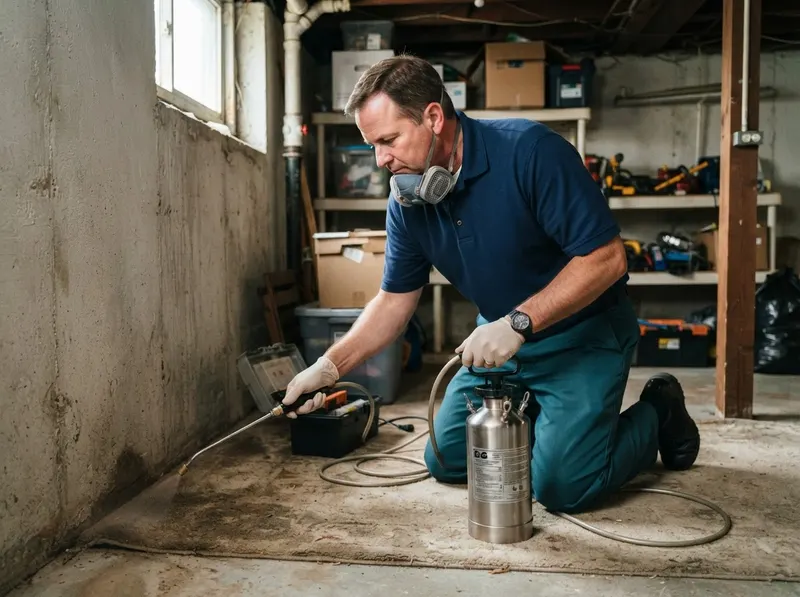
Eradication protocols follow a 4-step sequence: Step 1 consists of structural perimeter vacuuming using sealed HEPA filtration to extract loose pupal cocoons and eliminate surface organic detritus along sill plates. Step 2 introduces targeted application of an insect growth regulator (IGR) directly into foundation cold joints, flagstone crevices, and sub-slab cracks where larvae shelter from light. Step 3 deploys a non-repellent adulticide mist across exposed concrete slabs, sump pump perimeters, and floor drain recesses to eliminate active host-seeking adults. Step 4 entails perimeter barrier treatment around walk-out bulkheads and street-level access doors in Charlestown and East Boston to prevent re-infestation from urban wildlife corridors.

Basement Flea and Tick Eradication cost in Boston

Unfinished Basement Assessment & Spot Remediation (Under 600 sq ft)$200 - $275
Standard Historic Rowhouse Basement Eradication (Fieldstone / Brick)$275 - $385
Large Multi-Family Cellar & Shared Foundation Program (Dorchester / Allston)$385 - $550
Severe Subterranean Larval Infestation with Rodent-Vector Sanitation$475 - $650

Every job gets a firm, written price after a free on-site visit.

Common questions

How much does basement flea and tick eradication cost in Boston?
Basement flea and tick eradication in Boston carries a minimum service charge of $200 for localized basement assessments, while typical historical fieldstone basements range between $275 and $450 depending on square footage, foundation substrate material, and moisture severity.
Are cellar flea and tick treatments safe for multi-family walkup residents in Boston?
Cellar treatments utilize water-based, non-staining formulations that adhere directly to basement masonry and floor seams, requiring only a 3-to-4-hour dry window during which residents and pets remain out of the immediate basement zone before normal structural use resumes.
Why do fleas and ticks persist in older Boston brick and fieldstone foundations?
Old fieldstone and brick party walls in Boston retain high natural humidity and subterranean temperature stability, which prevents flea pupae and deer ticks from desiccating and allows dormant cocoons to survive undisturbed for months inside unsealed mortar joints.
Do I need to clean out my entire basement before the eradication team arrives in Boston?
Homeowners should clear a 2-foot perimeter along foundation walls, elevate stored cardboard boxes off concrete floors, and thoroughly vacuum exposed horizontal floor surfaces prior to arrival, while antique shelving and heavy mechanical systems can remain safely in place.
Will eradication treatments damage historic lime mortar or antique brick in Boston homes?
Formulations are pH-neutral and water-suspended, engineered specifically to neutralize insects without etching soft historic lime mortar, staining salvaged brick, or degrading 19th-century hand-hewn structural timber sill plates.
Helpful resources

Trusted references & local links

USA.gov, government & consumer helpBetter Business BureauFTC Consumer AdviceU.S. Small Business AdministrationReady.govU.S. EPAENERGY STARU.S. Dept. of EnergyConsumer.govU.S. Census BureauGoogle Maps, Boston, MA

Get started today

Tell us about your basement flea and tick eradication job in Boston and we'll send a clear, written quote, usually the same day.

Get your free pest control service quote, Boston

We only use your ZIP to check availability, no spam.