Laxora ExterminatingLaxora Exterminating

Multi-Unit Cockroach Containment Boston

Shared infrastructure defines Boston housing stock, from brick row houses in the South Boston and Charlestown neighborhoods to three-family wood-frame homes in Dorchester and East Boston. In these multi-family…
Get My Free Estimate →(339) 463-4995
Multi-Unit Cockroach Containment in Boston, MA
Quick answer
  • What is included: Comprehensive pipe-chase inspections, non-repellent insect growth regulators (IGRs), targeted gel baiting, and copper mesh exclusion around shared wall breaches.
  • Service timing: Initial assessments require 60 to 90 minutes per structure, with localized treatment protocols completed within 2 to 4 hours.
  • Standard pricing: Ballpark investments start at $200 for single-unit targeted exclusion, scaling to $450-$1,200 for full brownstone or triple-decker structural containment, confirmed on-site.
  • Targeted materials: High-potency non-repellent baits, precision dusts, and architectural containment seals that safeguard historic horsehair plaster and hardwood trim.
  • Arranging service: Structural evaluations can be scheduled directly by calling Laxora Exterminating at (339) 463-4995.

Shared infrastructure defines Boston housing stock, from brick row houses in the South Boston and Charlestown neighborhoods to three-family wood-frame homes in Dorchester and East Boston. In these multi-family dwellings, German cockroaches (Blattella germanica) rarely remain isolated in a single kitchen. Instead, they exploit continuous pipe chases, radiator risers, balloon framing, and voids behind antique baseboards to traverse between units. Conventional aerosol foggers exacerbate the problem by triggering repellent scattering, driving populations deeper into shared party walls. Multi-unit cockroach containment resolves this dynamic by prioritizing precision baiting, perimeter isolation, and mechanical barriers over broad-spectrum chemical broadcasts.

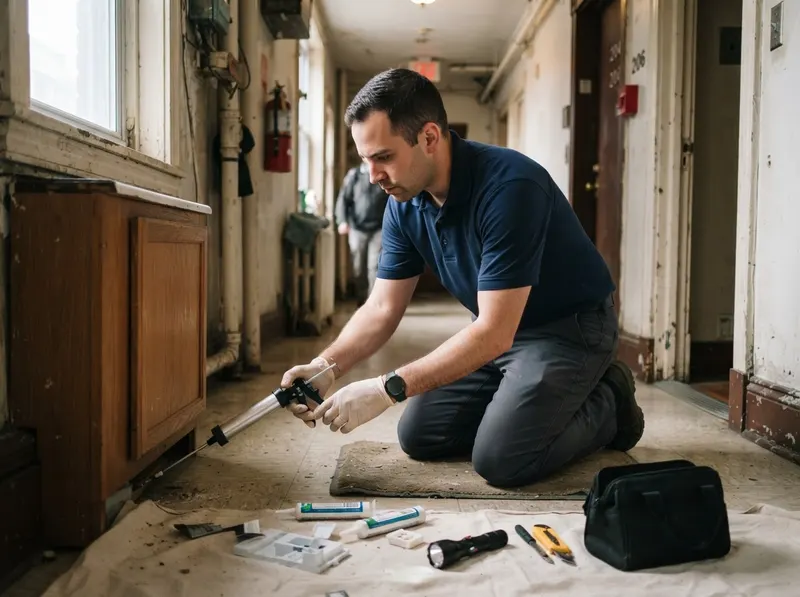
The mechanical containment process begins with an audit of vertical utility conduits. In properties across Back Bay, Beacon Hill, and the North End, century-old plumbing runs and decorative radiator sleeves create direct travel corridors between floors. Containment protocols install escutcheon plates backed with non-corroding copper mesh and elastomeric sealants, closing gaps around 0.5-inch to 2-inch supply pipes without damaging historic lath or antique heart-pine flooring. This physical separation prevents insects from escaping treated zones, isolating the population within measurable containment sectors where targeted, low-volatility gel baits and insect growth regulators can eliminate the colony without airborne residue.

Decision guidance depends on the building's internal layout and the spread of activity. If cockroach sightings occur exclusively near a single kitchen sink with no shared plumbing wall, single-unit exclusion and localized baiting suffice. However, if visual counts exceed 5 cockroaches per night across multiple rooms, or if adjacent tenants in Jamaica Plain or Allston-Brighton walkups report simultaneous activity, multi-unit structural containment is necessary. The operational trade-off involves coordination: single-unit surface treatments require minimal tenant scheduling but leave adjacent wall voids vulnerable, whereas comprehensive multi-unit containment requires coordinated access across vertically stacked kitchens to seal shared chases permanently.

Multi-Unit Cockroach Containment cost in Boston

Single-Unit Targeted Exclusion & Baiting$200 - $325
Two-Family Shared-Wall Containment$350 - $550
Three-Deck (Triple-Decker) Vertical Chase Sealing$600 - $875
Four-to-Six Unit Brownstone Perimeter & Chase Protocol$900 - $1,450

Every job gets a firm, written price after a free on-site visit.

Common questions

Why are cockroaches moving between apartments in Boston buildings?
Cockroaches move between Boston apartments primarily through unsealed gaps around steam radiator pipes, electrical conduits, and shared plumbing chases inside balloon-framed or masonry party walls.
Will cockroach containment treatments harm historic plaster or woodwork in Boston homes?
No, multi-unit containment uses targeted gel baits placed in concealed hinges and copper mesh seals behind existing fixtures, preventing damage to historic horsehair plaster, ornamental trim, and original hardwood.
Are the containment products safe for indoor pets in poorly ventilated Boston walkups?
Targeted baiting and physical exclusion protocols utilize non-volatile gels and enclosed bait matrices placed inside wall voids, avoiding airborne pesticide mists in low-ventilation spaces.
What preparation is required before Boston multi-unit containment begins?
Residents must clear areas beneath kitchen sinks, empty lower pantry cabinets, and remove personal clutter within 3 feet of radiator risers to allow thorough mechanical inspection and sealing.
How long does it take to halt German cockroach movement in a Boston multi-family property?
Mechanical pipe-chase exclusion blocks travel paths immediately, while non-repellent baits and insect growth regulators typically achieve complete population collapse within 14 to 21 days.
Helpful resources

Trusted references & local links

USA.gov, government & consumer helpBetter Business BureauFTC Consumer AdviceU.S. Small Business AdministrationReady.govU.S. EPAENERGY STARU.S. Dept. of EnergyConsumer.govU.S. Census BureauGoogle Maps, Boston, MA

Get started today

Tell us about your multi-unit cockroach containment job in Boston and we'll send a clear, written quote, usually the same day.

Get your free pest control service quote, Boston

We only use your ZIP to check availability, no spam.