Eastern subterranean termites enter Boston structures by migrating upward from damp soil through micro-fissures in historic fieldstone foundations, granite block footings, or settling brick party walls. In dense…
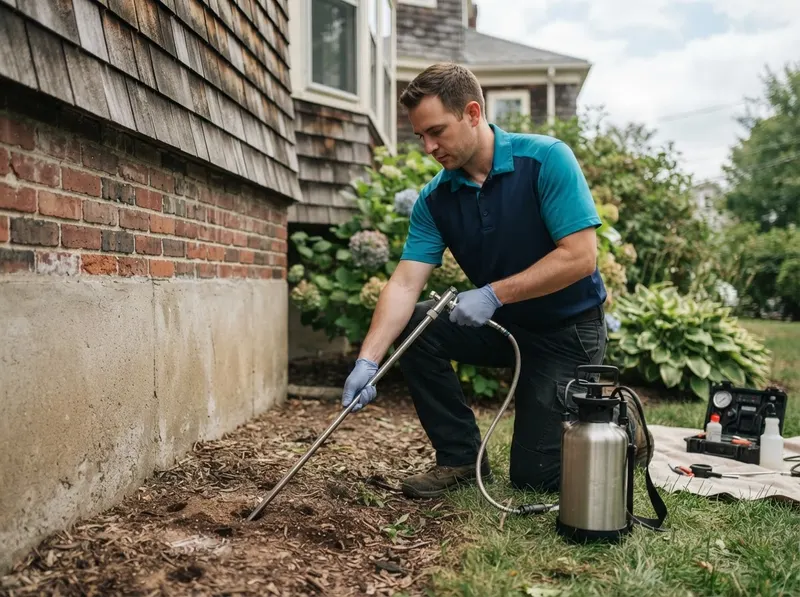
Eastern subterranean termites enter Boston structures by migrating upward from damp soil through micro-fissures in historic fieldstone foundations, granite block footings, or settling brick party walls. In dense neighborhoods like Back Bay and Beacon Hill, structures frequently share subterranean masonry where hidden settlement cracks permit mud tube construction directly behind interior lath and plaster. Subterranean termite perimeter defense establishes an uninterrupted barrier at the soil-to-masonry transition zone. Using low-pressure injection, non-repellent liquid termiticides bind directly to exterior soil particles at depths of up to 4 feet, allowing foraging worker termites to transfer the active material throughout the subterranean colony without signaling avoidance behavior.
Property construction type determines the installation method. Continuous exterior trenching applies to earth-contact perimeters common on wood-frame triple deckers in Dorchester, Jamaica Plain, and Brighton. In contrast, row houses in the North End, Charlestown, and South Boston often require precision diamond-core drilling through brick pavers or perimeter sidewalks at 12-inch intervals to reach sub-slab soils. The trade-off between exterior liquid trenching and non-invasive subterranean bait stations rests on ground disturbance versus eradication speed: liquid soil treatments provide immediate structural shielding by saturating the foundation boundary, whereas bait monitoring systems eliminate subterranean colonies gradually over 60 to 120 days while keeping historic flagstone or brick flatwork intact. A localized spot treatment addresses isolated mud shelter tubes in a basement, but leaving the broader foundation line untreated exposes perimeter sills to adjacent subterranean foraging.
Standard city trenching procedures must preserve the structural integrity of New England architectural substrates. In Allston and East Boston, masonry moisture levels near Boston Harbor and low-lying ground planes accelerate structural wood softening, creating high-risk targets for Reticulitermes flavipes along rough-sawn dimensional lumber. Subterranean termite perimeter defense utilizes targeted rod injection along perimeter sills without saturating antique interior finishes or running high-pressure lines near porous historic lime mortar. For contiguous urban lots, inspections evaluate boundary fence lines and exterior retaining walls to map termite foraging paths within Suffolk County soils before treatment lines are finalized.
Every job gets a firm, written price after a free on-site visit.
Tell us about your subterranean termite perimeter defense job in Boston and we'll send a clear, written quote, usually the same day.
 Laxora Exterminating